
When someone searches on Google, Google displays results within seconds using a smart ranking system powered by Google algorithm updates 2025. These updates help Google evaluate relevance, content quality, and user intent to decide which websites deserve visibility. Through continuous updates, Google refines search results to deliver accurate, helpful, and user-focused content.
What is the Google algorithm
The Google Search determines which webpages appear in search results and in what order. The algorithm evaluates many factors to decide which pages best address the query and deserve higher rankings. Google regularly rolls out major algorithm changes to improve search results.
How Does Google’s Algorithm Work?
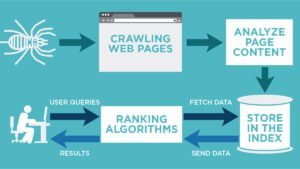
The Google algorithm is made up of multiple systems that handle different parts of the search process. These algorithms work together to discover web pages, store them in Google’s index, and display the most relevant results for each search query.
Here’s an overview of how Google finds, evaluates, and ranks web pages:
-
Crawling
Google Boats discovers a web page, collects the content, links, and codes, and then all the collected data is sent to Google services for indexing
-
Indexing
Google reads the data about what the page is about and how high-quality it is to decide if the page should be added to the Google index, and the data becomes eligible to show up in Google search
-
Ranking
When someone does a search, Google decides which webpage appears in the search results. The algorithm comes into play at this point to show pages that are most likely to be relevant and helpful to the user’s query.
Changes in Google algorithm in 2025
In its early years, Google released relatively few algorithm updates. Today, however, Google continuously refines its algorithms to ensure users receive the most relevant and high-quality search results. While many recent updates are minor and go largely unnoticed, others cause significant changes to search engine results pages (SERPs), such as:
- RankBrain
- Hummingbird
- Panda
- Penguin
- BERT(Bidirectional Encoder Representations from Transformers)
- Payday Loan Algorithm
- Mobile Update
- Update Fred Pigeon
- Page Layout Algorithm
- Exact Match Domain
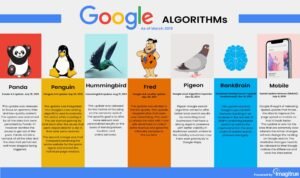
Here, the focus of these major Google updates was to improve the quality of sites and content that is going to show up on Google.
-
Rank brain
Google RankBrain is a machine learning–based algorithm that helps Google understand search queries and deliver more relevant results. It studies how users interact with search results and applies those insights to improve future responses. Before RankBrain, Google’s algorithm relied entirely on hand-coded rules. With RankBrain, Google can interpret user intent and continuously learn to provide more accurate and satisfying search results.
What is Hummingbird and how it works
Google launched the Hummingbird algorithm in 2013, marking a major shift in its core search system. This update enables Google to better understand complex and conversational queries and deliver more relevant results. Using natural language processing, Hummingbird interprets the meaning behind user searches by analyzing word context, synonyms, and related terms. It also considers factors such as user location, device type, and search history to provide the most accurate results.
-
Panda algorithm
Google introduced the Panda algorithm in February 2011 to improve search result quality by lowering the rankings of websites with low-quality content. As one of Google’s earliest updates focused on content quality, Panda helped remove irrelevant and low-value pages, making it easier for users to find valuable information. Although Panda is no longer a standalone update, Google has fully integrated its principles into the core algorithm, where they continue to influence rankings today.
-
Penguin
In 2012, Google rolled out a webspam update aimed at reducing link spam and deceptive link-building methods. The algorithm later became known as the Penguin update after Matt Cutts, Google’s former head of webspam, confirmed it in a tweet. While Google officially named the algorithm Penguin, it was designed to penalize unnatural links.
According to Cutts at SMX Advanced 2012, Panda focused on low-quality content, and Penguin was later launched to handle persistent spam
-
What is BERT
BERT is a deep learning language model designed to improve the effectiveness of natural language processing (NLP) tasks. It stands out for its ability to understand context by analyzing relationships between words in both directions. Google researchers introduced BERT in a 2018 paper titled “BERT: Pre-training of Deep Bidirectional Transformers for Language Understanding.” Since then, the model has been refined for use across fields such as biology, data science, and healthcare.
-
Payday Loan Algorithm
As digital marketing and SEO continue to evolve, staying informed about Google’s algorithm updates is essential. The Google Payday Loan algorithm specifically targets spam-heavy search queries and has had a major impact on industries that rely heavily on SEO. If your website operates in a niche frequently affected by spam, understanding this update is crucial. The algorithm works to clean up search results by lowering the rankings of sites that use unethical or manipulative tactics, delivering more reliable results to users.
-
Mobile Update
Mobile applications are updated regularly and contribute a large share of overall internet traffic. To minimize update overhead, differencing algorithms compute a small delta between the previous and updated versions. A variety of differencing algorithms have been proposed through ongoing research. The mobile update algorithm boosts the visibility of websites that are optimized for mobile devices
-
Update Fred Pigeon
The Fred algorithm update targeted low-quality websites that depended on thin content and aggressive ad placement. Most affected sites depended on content for traffic, even though not all were affiliate sites.
-
Page Layout Algorithm
On January 19, 2012, Google launched the Page Layout Algorithm update, commonly known as the “Top Heavy” update. This change targeted websites that placed excessive static advertisements above the fold, which pushed main content down and forced users to scroll. The update aimed to lower rankings for pages cluttered with ads at the top. Google stated that fewer than 1% of websites were affected, but those impacted needed to improve usability. Notably, the update did not target pop-ups or overlay ads.
-
Exact Match Domain
On September 27, 2012, Google rolled out the Exact Match Domain algorithm update. The purpose of the update was to target low-quality websites using exact-match domains for ranking advantages. Google shifted focus toward relevance and quality rather than keyword-rich domains. Google began prioritizing relevance and quality over keyword-rich domains. Examples include:
- hotelsinnewyork.com
- bestcarinsurance.net
- cheapflights.org
Keyword-rich domains may add value when paired with quality content, but they no longer ensure top rankings.
DigitrxSolutions stays ahead of Google updates to boost rankings, protect traffic, and build lasting digital authority.